Water Pump Tester Set, 8 pcs
-
Code:6750
-
Weight:1.010 Kgs
Overview:
✔ Tests mechanically driven water pumps without removal
✔ Measures coolant flow during engine operation
✔ Helps diagnose reduced water pump performance
✔ Detects damaged impellers, seized pump shafts and slipping drive belts
✔ Suitable for testing with the water pump installed
✔ Complete 8-piece diagnostic set

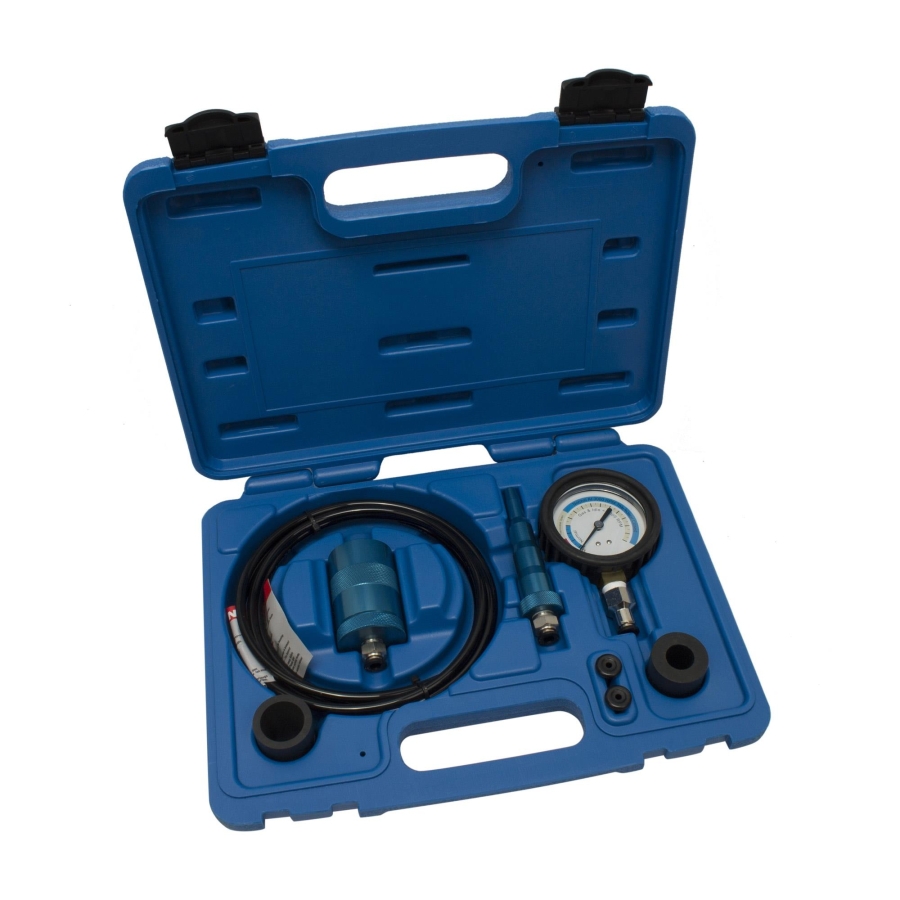
This water pump tester is designed to check the operation of mechanically driven engine coolant pumps while the engine is running.
The tester measures the pressure increase generated by the flowing coolant, providing an effective indication of coolant circulation and water pump performance.
It allows water pump faults to be diagnosed without removing the pump, reducing diagnostic time and unnecessary component replacement.
Detects Common Water Pump Faults
The tester helps identify water pump problems caused by:
- Damaged or broken water pump impellers
- Seized water pump shafts
- Slipping drive belts
- Reduced coolant circulation
Many modern water pumps use plastic impellers. If the impeller breaks internally, it may no longer be securely connected to the pump shaft, resulting in reduced coolant flow while the pump appears normal from the outside. This tester makes it possible to detect such failures with the pump still installed.
Operating Requirements
Before performing the test:
- Engine must be completely cold.
- Thermostat must be installed and closed.
- Coolant level must be correct.
- Cooling system must be properly bled.
- Follow all applicable safety precautions.
Scope of Delivery
- Pressure gauge (0–15 psi)
- 2 rubber seals
- 2 blanking plugs
- Two-piece tube connector
- 2 m hose, Ø 6 mm
- Hose connector
Original numbers are for comparison purposes only. This is not an original manufacturer tool/product.
Connection Procedure
The connection method depends on the type of cooling system installed in the vehicle.
Vehicles with an Expansion Tank
Most vehicles equipped with an expansion tank have an auxiliary hose running directly between the expansion tank and the thermostat on the engine side.
To connect the tester:
- Disconnect the auxiliary hose from the expansion tank.
- Connect the tester directly to this hose.
- Sealing the now-open connection on the expansion tank can prevent coolant loss but is not required for the test.
Some vehicles with an expansion tank have the auxiliary hose connected to the radiator side of the thermostat.
In these cases, the tester must be connected to a hose that provides direct access to the engine block. In most applications, this is the heater core hose connected directly to the engine.
Vehicles without an Expansion Tank
On cooling systems without an expansion tank, the tester must also be connected to a hose with direct access to the engine block.
In most cases, the heater core hose connected directly to the engine provides the correct connection point.
Connection Options
Connecting to a Pipe
- Select the two-piece pipe connector and the appropriate pipe seals according to the outside diameter of the pipe.
- Remove the upper section of the connector.
- Install the seal with the larger internal diameter facing the pipe being sealed.
- Reinstall the upper section and tighten it lightly.
- Slide the complete assembly over the pipe.
- Tighten the upper section further to achieve a proper seal.
- Connect one end of the 6 mm plastic hose to the push-fit connector and the other end to the tester.
If an open pipe must be sealed to prevent excessive coolant loss:
- Install the adapter as described above.
- Seal the adapter using the supplied sealing component.
Connecting to a Hose
- Insert the male hose connector fully into the hose.
- Secure it with a hose clamp if necessary.
- Connect one end of the 6 mm plastic hose to the push-fit connector.
- Connect the other end to the tester.
To disconnect the plastic hose from the push-fit connector:
- Press the outer collar of the connector inward.
- Pull the plastic hose straight out.
Interpreting Test Results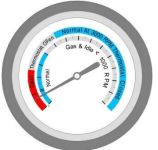
Idle Speed Test (Below 1,000 RPM)
Read the pressure value on the inner scale.
Result: Needle remains steadily within the blue zone.
Diagnosis: Water Pump Operating Correctly
At idle speed, there should be no significant pressure increase, and the gauge reading should remain stable.
Idle Speed Test (Below 1,000 RPM)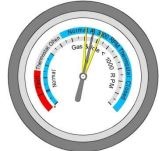
Read the pressure value on the inner scale.
Result: Pressure rises rapidly or the needle oscillates.
Diagnosis: Cooling System Fault
The presence of gas in the cooling system may indicate a leaking cylinder head gasket or another source of combustion gases entering the cooling system.
Engine Speed Test (2,500–3,000 RPM)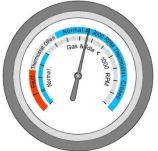
Read the pressure value on the outer scale.
Note: Slight pressure fluctuations of less than two scale divisions are acceptable.
Result: Pressure increases with engine speed and remains stable while RPM is held constant.
Diagnosis: Water Pump Operating Correctly
The pump is circulating coolant as expected.
Engine Speed Test (2,500–3,000 RPM)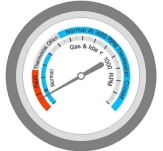
Read the pressure value on the outer scale.
Result: No pressure increase.
Diagnosis: Water Pump Fault
No pressure increase indicates that the pump impeller is broken or seized.
Engine Speed Test (2,500–3,000 RPM)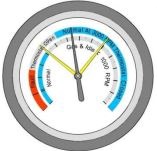
Read the pressure value on the outer scale.
Result: Needle oscillates by more than two scale divisions.
Diagnosis: Water Pump Fault
Excessive needle oscillation indicates one of the following:
- Slipping drive belt
- Damaged pump impeller
- Damaged pump shaft
Important Notes
This tester is designed to evaluate coolant flow and water pump performance only.
It cannot detect:
- Cooling system leaks
- Damaged seals or gaskets
- Collapsed coolant hoses
- Blockages within the cooling system
If no combustion gases are detected in the cooling system and the water pump is operating correctly, engine overheating may instead be caused by:
- A faulty thermostat
- Incorrect air-fuel mixture
- Collapsed coolant hoses
- Defective radiator cap
- Cooling system blockage