Engine Timing Tool Kit for Jaguar Land Rover V8 3.2 / 3.5 / 4.0 / 4.2 / 4.4
-
Code:23045
-
Weight:2.200 Kgs
Overview:
✔ Professional timing tool kit for Jaguar & Land Rover V8 petrol engines
✔ Suitable for 3.2L, 3.5L, 4.0L, 4.2L and 4.4L engines
✔ Designed for timing chain adjustment and camshaft alignment
✔ Ensures precise locking of camshafts and flywheel
✔ Compatible with multiple OEM reference tools
✔ Ideal for workshop and engine service applications

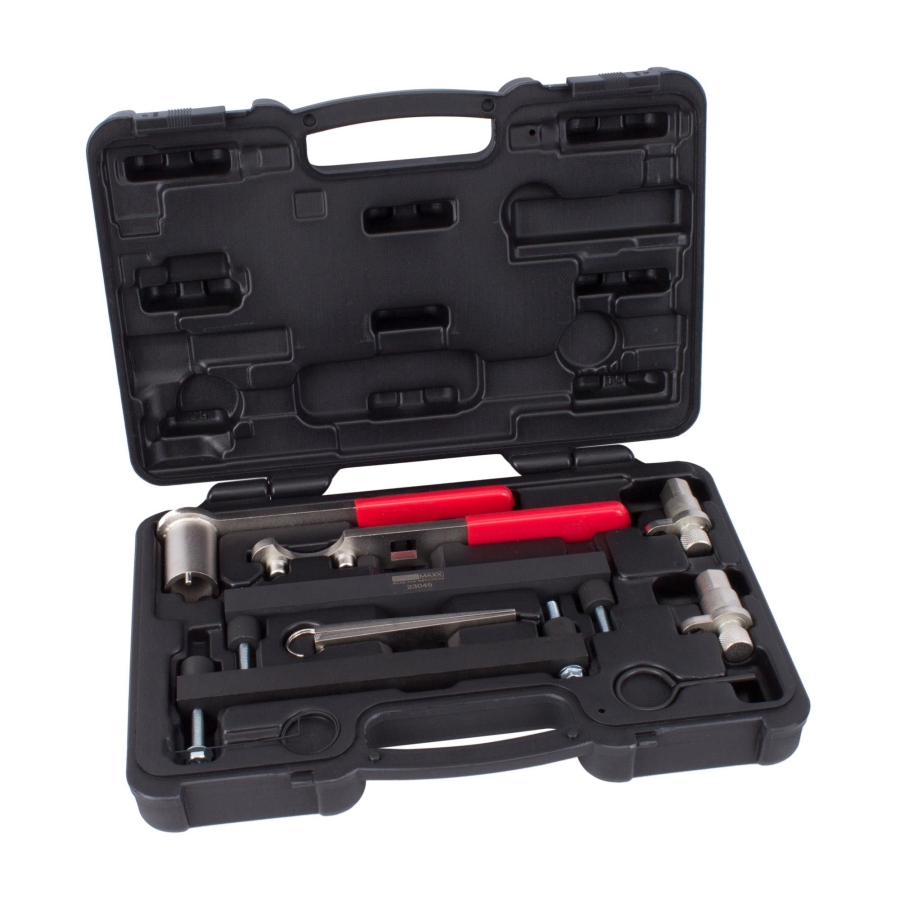
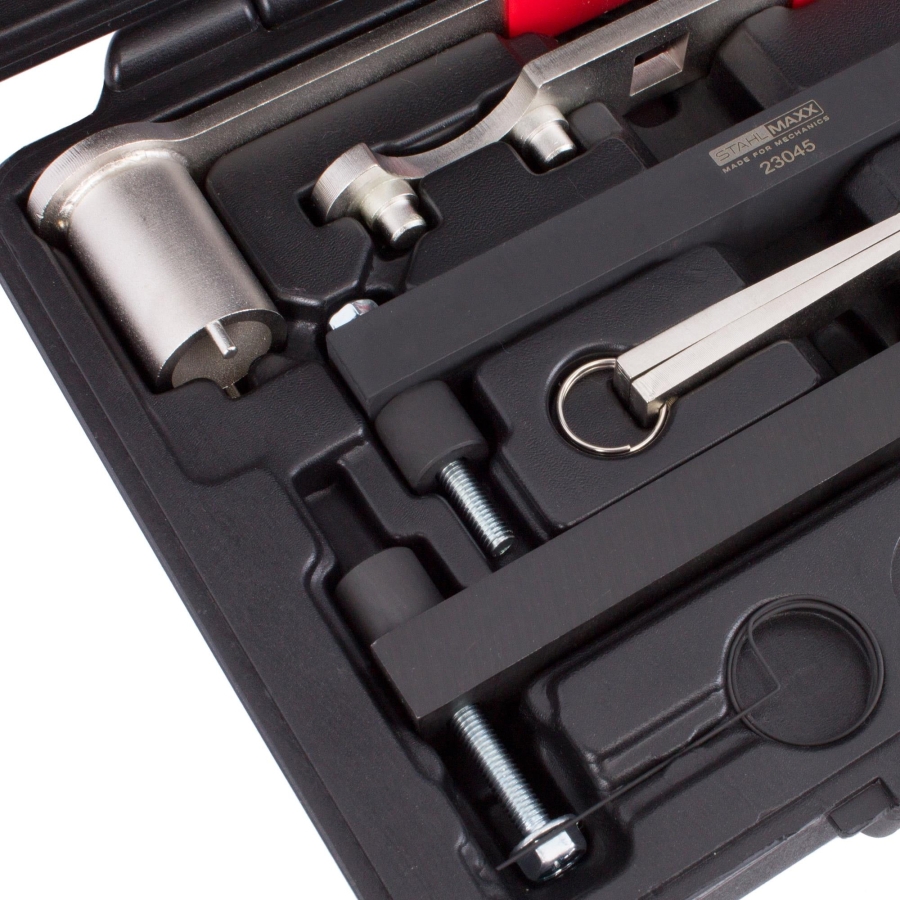
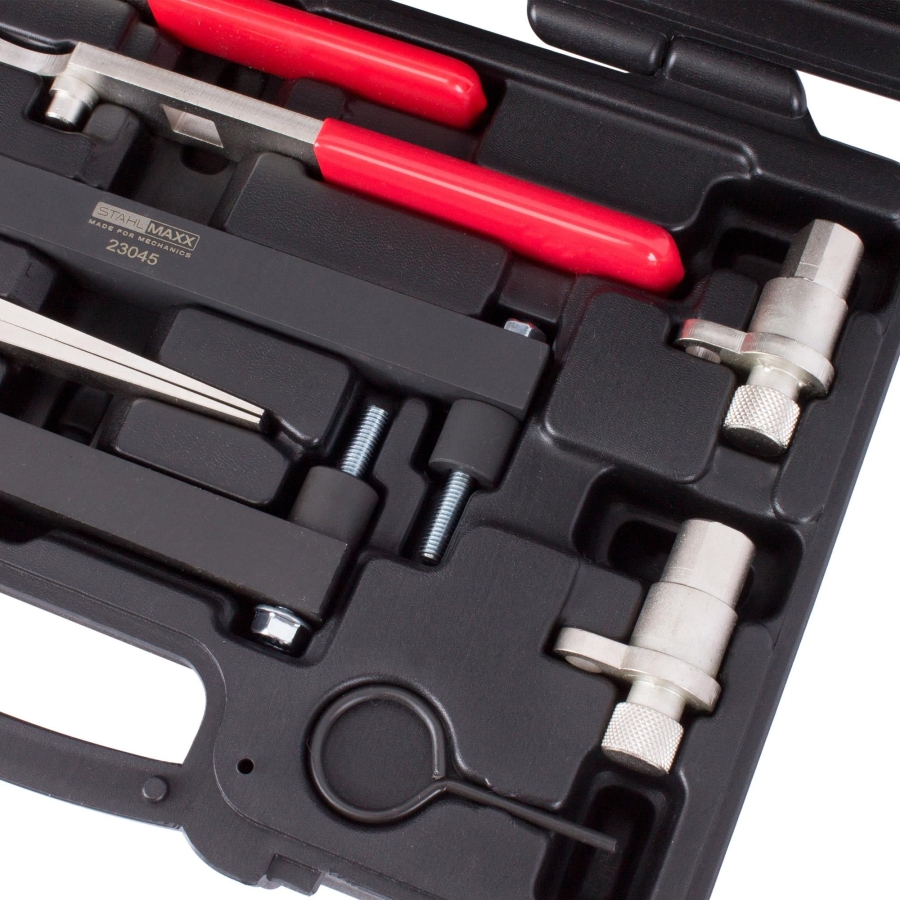
This specialized engine timing tool kit is designed for setting and locking the timing system on Jaguar and Land Rover V8 petrol engines equipped with timing chains. It enables precise alignment of camshafts and crankshaft during maintenance and repair operations.
Vehicle Compatibility
Jaguar:
S-Type, XF, XJ8, XJR, XK8, XKR
Land Rover:
Discovery 3, Range Rover (4.2 / Supercharged 4.4)
Daimler:
V8 Sport
Engine Compatibility
✔ 3.2L / 3.5L / 4.0L / 4.2L V8 petrol engines
✔ Motor codes: BC, LB, LC, GC, AC, KC, DC, CC, CE, NC, EC, PA, HB, 1B, RB, SB, TB, 3B, PC, NB
✔ Land Rover motor codes: 4PN 428PS, 448DT, 448PN 306PS
Important Note
For seized crankshaft pulleys, the use of additional tools is recommended:
✔ Puller set – item no. 12017
✔ Crankshaft holding tool – item no. 106704
(Not included in the kit)
Functions
✔ Aligns and locks camshaft timing positions
✔ Secures camshaft sprockets during service
✔ Locks flywheel for crankshaft positioning
✔ Assists in timing chain installation and adjustment
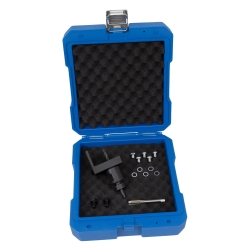
Included Tools
✔ Camshaft adjustment alignment tool – used as 303-654
✔ 2 x Camshaft setting/locking tools – used as 303-530
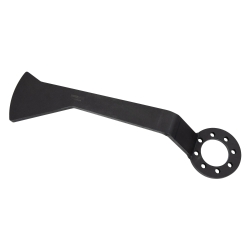
✔ Camshaft sprocket holding tool – used as 303-532
✔ 2 x Flywheel locking tools – used as 303-531 and 303-645
✔ Primary chain tensioning wedges – used as 303-533
✔ 2 x Timing chain tensioner locking pins
OEM numbers are provided for reference only. This product is not an original manufacturer tool.
Timing Check & Adjustment Overview
Checking Engine Timing
To verify correct valve timing, the engine must be locked in its timing position:
- A flywheel locking tool is used to secure the crankshaft via the flywheel.
- A camshaft alignment plate must be installed on each cylinder bank.
- The plates must sit flush on the cylinder head surface and align perfectly with the camshaft reference surfaces.
Flywheel Locking Pins
- Different locking pins are used depending on engine generation.
- They are color-coded and shaped differently to match the flywheel bore.
- The pin is inserted through the crankshaft position sensor (CKP) opening.
Important:
Using the wrong pin may allow partial insertion but will not align correctly or allow proper fastening. Always verify correct fitment.
Camshaft Alignment Check
- Camshaft covers must be removed to access alignment surfaces.
- With the engine locked:
- Camshaft reference flats must be correctly oriented.
- Alignment plates should sit perfectly flush without force.
If the plates do not fit correctly:
→ The timing is incorrect and must be adjusted.
When Adjustment Is Required
Correcting timing is not a minor adjustment. It typically requires:
- Removing the front timing cover
- Removing the crankshaft pulley
- Accessing timing chains, guides, and sprockets
- In some cases, partial disassembly of camshaft components
Key Principles for Timing Adjustment
1. Always Lock the Engine First
- Crankshaft must be secured in timing position before any work begins.
2. Work One Cylinder Bank at a Time
- This reduces the risk of misalignment and maintains control over timing reference points.
3. Never Force Alignment
- Camshaft alignment tools are not designed to pull components into position.
- The camshafts must be manually rotated into correct alignment before tightening tools.
- Forcing alignment can cause cylinder head damage.
Camshaft Sprocket Handling
- Bolts on camshaft sprockets must be loosened to allow adjustment.
- A counter-holding tool is required to prevent unwanted rotation.
Critical:
- Always use new sprocket bolts during reassembly.
Tightening Order Matters
This varies by engine generation:
- Earlier engines:
- Exhaust camshaft sprocket bolt is tightened first
- Later engines (Jaguar / Land Rover):
- Intake camshaft sprocket bolt MUST be tightened first
- Incorrect order can result in serious engine damage
Timing Chains & Sprockets – General Notes
Primary Chains
- Typically removed starting from the left bank, as chain routing overlaps at the crankshaft.
Crankshaft Sprocket
- Often a two-piece design
- Tooth alignment between front and rear sections is intentionally offset
- Misalignment here will result in incorrect timing across both banks
Secondary Chains
- Connect camshafts to intermediate sprockets
- Must be installed with correct tension and alignment before final tightening
Chain Tensioners
Two main types exist:
Older Type
- Requires manual compression and locking before installation
- Often includes sealing components that must be correctly refitted
Newer Type (Ratchet Mechanism)
- Self-locking design
- Do NOT release the ratchet prematurely during compression
- Incorrect handling can permanently damage the tensioner
Chain Installation Best Practices
- Ensure the drive side of the chain is tight (no slack)
- Slack must be positioned only on the tensioner side
- Prevent unintended rotation of variable valve timing (VVT) units during installation
Variable Valve Timing (VVT) Considerations
- Some engines require positioning the VVT unit in a fully retarded position before tightening
- Special tools may be required to hold this position
- Incorrect positioning will lead to timing errors or engine faults
Final Verification
After reassembly:
- Rotate the engine manually (typically two full turns)
- Reinstall locking tools
- Check that:
- Crankshaft locking pin fits correctly
- Camshaft alignment plates sit flush
If not:
→ Timing procedure must be repeated
DAIMLER DAIMLER XJ (X30_) (10.1994 - 06.2003) Six 4.0 (284 HP, 209 kW)
JAGUAR XJ (X308) (09.1996 - 06.2003) 4.0 (284 HP, 209 kW)
JAGUAR XJ (X308) (09.1996 - 06.2003) 4.0 (363 HP, 267 kW)
JAGUAR XK 8 Convertible (X100) (03.1996 - 12.2006) 4.0 (284 HP, 209 kW)
JAGUAR XK 8 Convertible (X100) (03.1996 - 12.2006) 4.0 (363 HP, 267 kW)
JAGUAR XK 8 Coupe (X100) (03.1996 - 12.2006) 4.0 (363 HP, 267 kW)
LAND ROVER DISCOVERY III (L319) (07.2004 - 09.2009) 4.2 4x4 (405 HP, 298 kW)
LAND ROVER DISCOVERY III (L319) (07.2004 - 09.2009) 4.4 4x4 (299 HP, 220 kW)
LAND ROVER DISCOVERY III (L319) (07.2004 - 09.2009) 4.4 4x4 (305 HP, 224 kW)
LAND ROVER RANGE ROVER III (L322) (03.2002 - 12.2012) 4.2 4x4 (396 hp, 291 kW)
LAND ROVER RANGE ROVER III (L322) (03.2002 - 12.2012) 4.2 Supercharged 4x4 (405 HP, 298 kW)
LAND ROVER RANGE ROVER III (L322) (03.2002 - 12.2012) 4.4 4x4 (299 HP, 220 kW)
LAND ROVER RANGE ROVER III (L322) (03.2002 - 12.2012) 4.4 4x4 (305 HP, 224 kW)
LAND ROVER RANGE ROVER III (L322) (03.2002 - 12.2012) 4.4 4x4 (306 HP, 225 kW)
LAND ROVER RANGE ROVER III (L322) (03.2002 - 12.2012) 4.4 D 4x4 (313 HP, 230 kW)
LAND ROVER RANGE ROVER IV (L405) (08.2012 - ) 4.4 SDV8 4x4 (313 HP, 230 kW)
LAND ROVER RANGE ROVER IV (L405) (08.2012 - ) 4.4 SDV8 4x4 (340 HP, 250 kW)
LAND ROVER RANGE ROVER SPORT (L320) (02.2005 - 03.2013) 4.2 4x4 (390 HP, 287 kW)
LAND ROVER RANGE ROVER SPORT (L320) (02.2005 - 03.2013) 4.2 4x4 (396 HP, 291 kW)
COUNTRY ROVER RANGE ROVER SPORT (L320) (02.2005 - 03.2013) 4.2 4x4 (401 HP, 295 kW)
LAND ROVER RANGE ROVER SPORT (L320) (02.2005 - 03.2013) 4.2 4x4 (405 HP, 298 kW)
LAND ROVER RANGE ROVER SPORT (L320) (02.2005 - 03.2013) 4.4 4x4 (299 HP, 220 kW)
LAND ROVER RANGE ROVER SPORT (L494) (04.2013 - 12.2019) 4.4 SDV8 4x4 (340 HP, 250 kW)